Mere Being - 035 - October
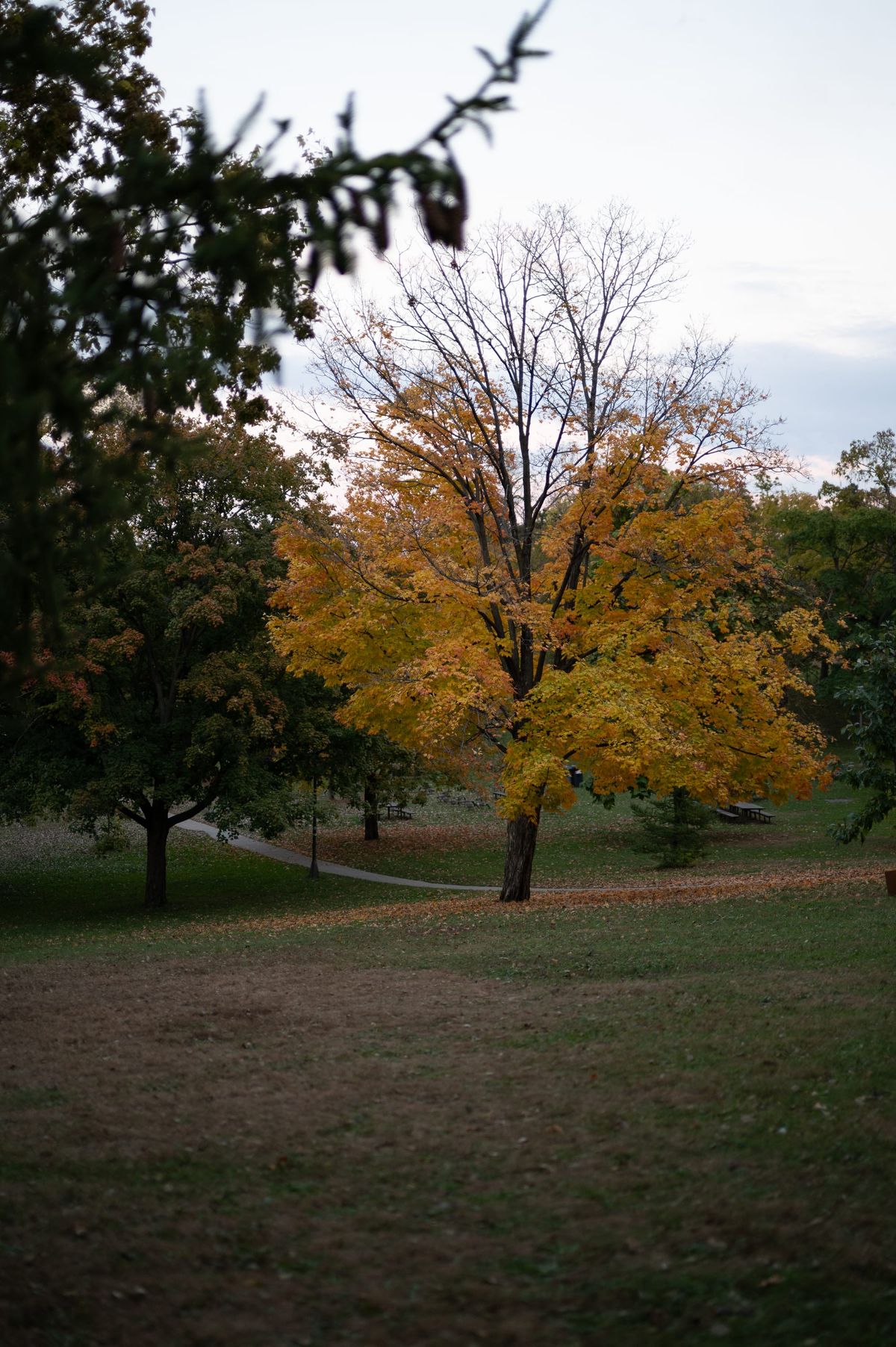
A few days after last month's issue I got sick again — fever, several days fully in bed, the whole bit — and then about a week of house guests, so it's been another month with that "hole punched through it" feeling. And now it's November! We've shifted fully from "the leaves are starting to turn" to "the leaves are dropping, and there are still a few trees hanging on." Big sections of the park are bare.
Word count for the Special Project now stands at 45,891 words. This is a little disappointing — less than 4,000 words in October, when I'd hoped to have more like 10,000 — but see "hole punched through the month," above. I still expect to be able to hit my ultimate 90,000 word goal for the first pass by the end of January. Will, at that point, I have something that even resembles a novel? Unclear. I have a lot of individual bits and pieces that I like, events and characters and moments, but every time I feel like it's coming together into a story I become dissatisfied, the direction I was so excited about when it came to me last night starts to feel dead on the page, and it all flings itself apart again. My real hope is that I can build something basically novel-shaped out of the pieces I'll have in the second draft.
The important thing, really, is to get back into the habit of spending at least 20 minutes on it a day. The outcome I need from this project is less the novel and more the process of writing the novel. What work habits work for me? I am learning that word count goals are less useful than goals for time spent doing nothing but looking at the word processor. Trying to hit 500 words can take a couple of hours, but twenty or so minutes spent writing can reliably produce 700 words. (I don't understand the math here either!)
I'm trying an experiment with Simpler Machines, the weekly newsletter, where I ask for and answer reader questions. So far, I've covered finding energy for creative work, the root cause of California's terrible housing market, and how the Impulse range has changed how I cook. I also wrote about why I write every day, and why it's useful as a creative practice.
The subscription graph for that newsletter continues to trend ever-so-slightly downwards, but answering questions rather than pulling topics out of the ether does make it easier and more fun to write. I continue to fear that what the newsletter lacks is a clear pitch — a reason beyond "you personally know me" to read it every week, and I'm really resistant to the feeling that I'm focused on a topic. I'm hoping that a few months of question-driven newsletters will make it more clear where the intersection of "my current interests" and "my current audience" lies.
If you've got a question, I'd love it if you took the time to send it to me.
Related to "how does top-of-funnel work"— I'm back on Mastodon. Come say "hi."
Mostly this month I've been reading Foreigner, a science fiction series by C.J. Cherryh, who I had somehow never heard of despite the fact that she's been writing since the 70s and has multiple Hugos. Truly, the world contains infinite detail.
I finished the fifth entry in the series earlier this week and am now taking a break to read a couple of other things in my queue, and let the person who recommended the series to me get out ahead of me again.
I loved the first book, enjoyed the rest of the first trilogy, and am finding myself less enthusiastic about the second. I had the series pitched to me on a combination mostly on the basis of, "the main character is a very socially anxious divorced man who spends most of his time worrying about whether people like him" and the first trilogy delivers on this, but it gets less like that as the series goes on and he gets more confident in both himself and his position in society.
The basic concept here is that humans accidentally arrive on a planet populated by an alien species called the atevi, who are slightly behind humans technologically and just similar enough to human beings for contact to be really dangerous. Humans accidentally start and then lose a war, and as a condition for that war they have to hand over all their technology— but slowly, so as not to destabilize atevi society too badly. So we end up in a situation where there's exactly one human being who's allowed to live with and translate for the atevi (human-atevi dictionaries are tightly controlled on the island where the rest of the humans live), who oversees the process of technology transfer. Our main character, Bren Cameron, is the latest of these diplomat-translators, and we follow his adventures as he attempts to do things like "translate spaceship designs," "prevent the atevi from destroying their environment and economy with highways" and "avoid getting poisoned by his boss's grandmother or kicked to death by her alien horses."
On that poisoning: One of the things I love about the world-building is that we repeat the idea that atevi are "just similar enough to be dangerous" several times. Atevi can eat human food — they particularly like tomatoes, which aren't supposed to be exported from the human island, but — and humans can eat most atevi food. But a lot of atevi food contains alkaloid poisons. Their diets in fact require a certain amount of alkaloids that would be deadly for humans. So it's easy for an atevi to accidentally poison a human, and even easier for an atevi to deliberately poison a human but leave their culpability ambiguous.
The social differences are more difficult to describe, and understanding them is more of what the plot is about, but they're similar in character though in reverse. Behaviors that humans consider routine, innocuous, and necessary are extremely destabilizing to atevi society — hence that "accidentally started a war" bit.
If you share my kind of perverse literary preferences, Bren Cameron is a delight. He's extremely competent at his difficult and technical job and terrible at personal relationships and his own feelings, and we spend a lot of time on What's Going On With Bren, because the novels are a little more "literary" than is typical for science fiction. We got a lot of interiority even in the conventional passages describing action, and then in between we get long stretches just dwelling on Bren's interior monologue. And boy, does this man dwell. Several books have an entire chapter that's basically, "what Bren Cameron thought about while he was trying and failing to sleep." He's very concerned about whether people like him, he's very concerned about offending people, he's very concerned about embarrassing people be seeming offended himself.
Oh, and, man, Bren's hair. Atevi all have long hair and keep it braided, so Bren has to have long hair. His hair gets described a lot. His mother doesn't like his hair. Atevi women love his hair. He's the only blond person they've ever seen. At one point he gets told that his new servants are fighting over who gets to braid it. There's some real "I want that twink Obliterated" energy to certain sections of the book; if you like that joke you'll probably like it.
There's more I want to write but this is already too long and some of the things I want to write about are related to important surprises in the book, so: I give you one month to read it.
Beans? Beans. My local co-op stocks a handful of Rancho Gordo beans now, so my life is complete. One of them is the Yellow Eye Beans called for in their New England Baked Beans recipe. I warn you: Smelling these beans caused me, for just a moment, to experience the disquieting urge to root for the Patriots. It passed, I survived.
I doubled the bacon in this recipe because I had a lot of bacon, and I'm not sure that was actually a good call. These beans were a lot. By the time we got through with them we were Pretty Done. It's been a few weeks though and I have more bacon in the fridge, so if I can get out to the store for more onions there will probably be more beans.
That's all I've got for you, for now. Read Foreigner! And send me a question!
More soon— Nat.