Want to be happier at work? Try joining a church
If you also find yourself struggling to make work feel sustainable, maybe the problem isn't really with the work— and maybe you can't fix it by thinking more about the work.
I spend a lot of time thinking, and writing, about how to have a happy and meaningful work life. I've always subscribed to the idea that since work takes up about half of my waking hours, I want to enjoy what I'm doing with those hours, or at least not be miserable during them.
For a long time that meant thinking a lot about my work. If I was unhappy with a job I'd try to fix the job, or get a new one. I spent a lot of time thinking about what I needed from work. I tried working on the most important work I could get, and optimizing for social and professional status. I tried quitting that job and optimizing for free time. I tried optimizing for the activities that I most enjoy in the work— writing more code and less Terraform. I tried getting promoted. I tried leading teams. I tried not leading teams. I tried avoiding getting too close to any of my coworkers. I tried becoming friends with my coworkers. I tried avoiding getting too close to any of my coworkers again. I tried working for companies where the mission really mattered to me. I tried working for companies where I didn't particularly care about the mission and could remain detached from it. I tried working for big companies. I tried working for tiny companies. I tried starting my own company.
Over the past year I've come to believe that all of this was me falling prey to workism, the belief that work "defines a person's purpose in life." I was implicitly accepting that my life needed to be organized around work, that work was where I was going to find contentment and satisfaction and my sense of place in society.
Now I believe that the key to being happy at work is taking it out of that central place. I need to get my sense of meaning and purpose from my life outside of my work: My family, my friends, my spiritual life, and especially from my role in my community. If I have that sorted, it's much easier to figure out the work part.
The key for me seems to be the regular physical presence of other human beings, in relationships that are not transactional. Relationships that are instead based on a combination of shared values, and gifts.
This probably deserves its own dedicated essay, but there's something magical about non-transactional relationships. These aren't relationships where there's no resource exchange— often quite the opposite, in my non-transactional relationships I'm constantly giving and getting things— but where the resource exchange is informal, fluid, and often quite asymmetrical. There's maybe an expectation that the accounts will balance out over the very long run, or across the whole network of individuals exchanging gifts, but you don't have to be immediately useful to start showing up, and you don't have to stay useful to keep showing up.
Often in these communities, needing something is itself a gift.
For me right now I have... five of these communities? Depending on exactly how you draw the boundaries, maybe a few more. My Zen center, my improv community, my neighborhood in Minneapolis, my family and my partner's family, my friends-who-are-family.
The size and the type of gifts varies a lot. A few weeks ago we helped dig out and repair our neighbor's pond. At the Zen center I give dhana. At improv, I pay for classes, and I donate money for the space and the teachers, but I also give (and get!) gifts within improv itself, intensity and attention and ideas. And laughter. My friends buy me dinner and get involved in my hobbies. When I see a particularly cool CRTV I always try to get a photograph of it, for a friend I know who collects them.
I said "church" in the title because a good religious community is the best way I know to find one of these places. There's a certain durability to a community that's based on a shared understanding of and relationship to the metaphysical that I've never quite found anywhere else. It doesn't have to be a church — for me, it's not.
But even Christian churches aren't all what their loudest, meanest adherents would have you believe. Keep an eye out for the ones that fly Pride flags, that show up for immigrants, and that are deeply engaged with interfaith organizing. A huge amount of the response up here to Operation Metro Surge was organized through churches— grocery runs and driving kids to school.
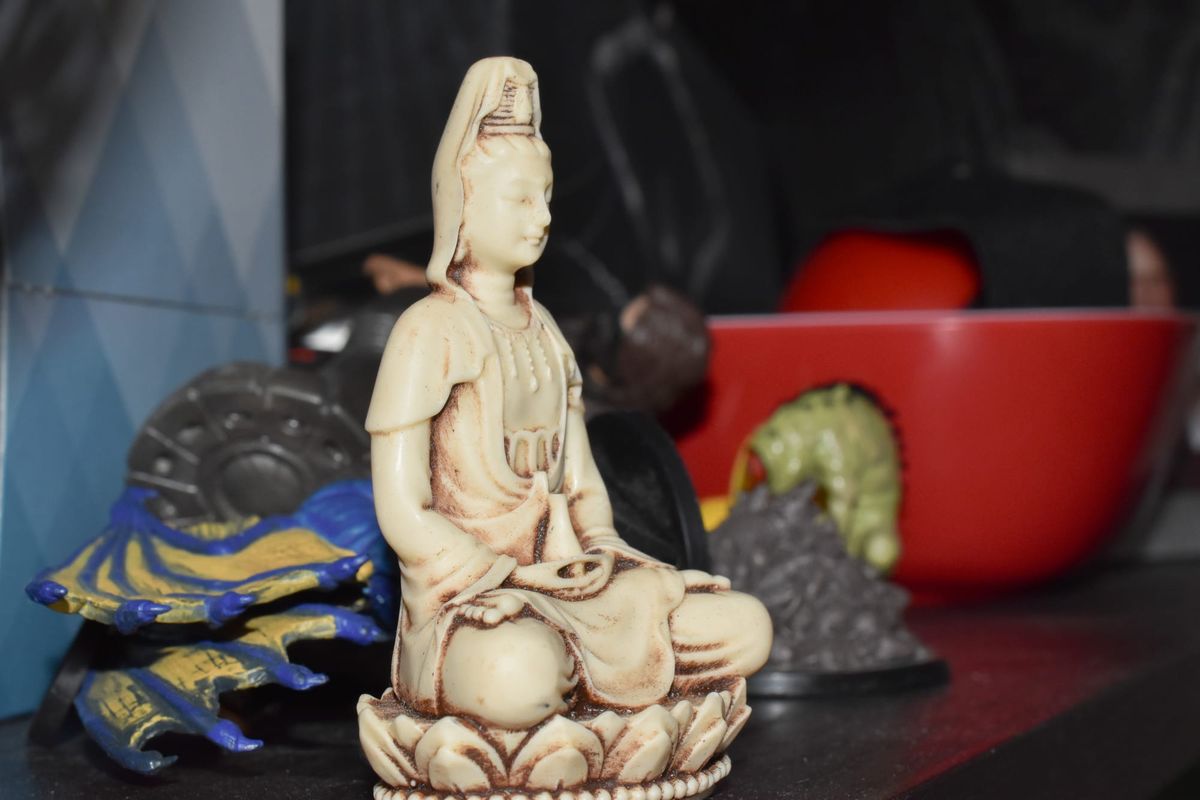
Also— have you ever sat for an hour or so in a room where everyone in that room shared the same general sense of, "Why we're here, and what we should do about it?" If you haven't, I highly recommend spending some time— on the order of a few years— finding what that room is, for you I got a little bit of it growing up in Unitarian Universalist congregations— the "free and responsible search for truth and meaning" and all that— but man, when I finally came to Soto Zen properly— sitting in a sangha, meditating, reciting the heart sutra together— it's that stuff about the emptiness and interconnectedness of all things and all beings that's what really gets me going.
All of this isn't to say that work doesn't matter when it comes to being happy at work. Making the decision to engage deeply with your neighbors, with your community, with organizations outside of work— that is going to put certain bounds on the kind of work that you can do. In some ways this is the core of why I moved to Minnesota. Getting to a place where I have the time and the money and the energy to be able to engage with these communities consistently the way I need to required a much lower cost of living than was possible in California. That decision cost a lot.
But if you also find yourself struggling to make work feel sustainable, maybe the problem isn't really with the work— and maybe you can't fix it by thinking more about the work.
This newsletter is made possible by paid sponsors. If you enjoy Simpler Machines, consider joining. Thanks.